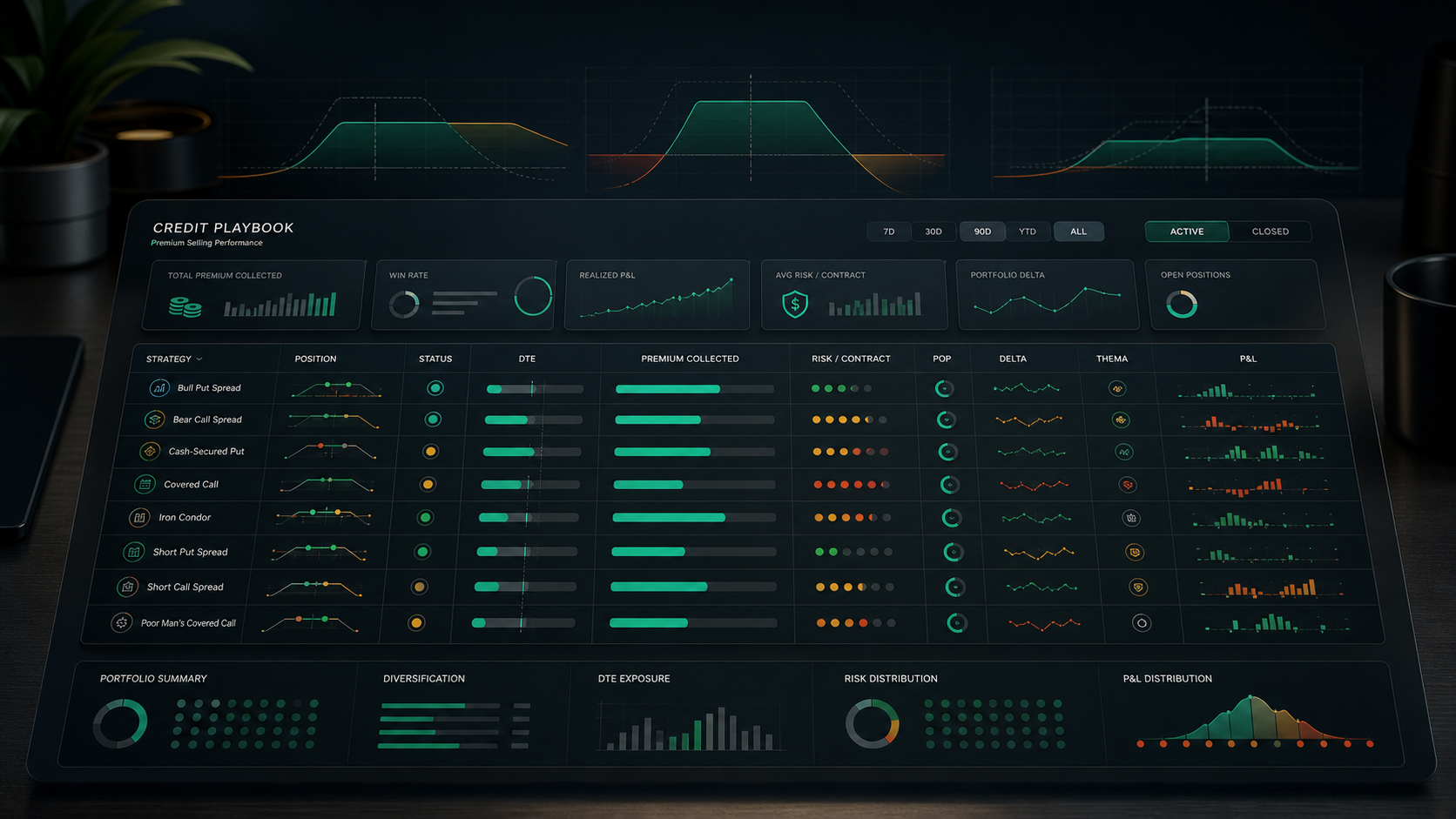
Premium-selling strategies need a different review surface than directional stock trades. The question is not only whether a position made money. Traders also need to know how much credit was collected, how much risk was carried, how many days the trade consumed, and whether the result justified the capital.
GammaLedger’s Credit Playbook is built around that review. It extracts credit-oriented positions and presents them in a dense table with filters, metrics, and strategy context.
What the Credit Playbook is for
The Credit Playbook is useful when you regularly trade:
- Cash-secured puts.
- Covered calls.
- Bull put spreads.
- Bear call spreads.
- Other credit spreads and premium-selling structures.
Rather than treating every trade as a generic row, the playbook focuses on premium collected, risk per contract, contracts, fees, P&L, ROI, DTE, and time in trade. It is a comparison view for repeatable income strategies.
Active versus closed review
Credit trades deserve both active monitoring and post-trade review. GammaLedger includes status filters so you can switch between active positions, closed outcomes, and all history.
For active trades, useful questions include:
- How much premium is still at risk?
- Which expirations are approaching?
- Which trades have large risk per contract?
- Which symbols dominate current exposure?
For closed trades, the review shifts:
- Which structures produced the best risk-adjusted outcomes?
- Did winners close quickly?
- Did losers stay open too long?
- Were fees material relative to credit collected?
Time horizon filters
Premium strategies can look different across regimes. A 30-day review might reveal recent volatility issues that disappear in all-time statistics. A year-to-date view might highlight strategy drift.
The Credit Playbook includes time horizon filters such as last 7 days, 14 days, 30 days, 90 days, 180 days, 365 days, month to date, year to date, and all time. Use them to keep the review anchored to the decision you are making.
Strategy and symbol filters
Filtering by strategy helps compare setups that have similar risk mechanics. A cash-secured put should not always be judged the same way as a defined-risk spread. A covered call on assigned stock has different context than a standalone short call.
Symbol filtering is equally important. If one ticker accounts for most closed losses, the strategy may not be the problem. Position selection, volatility regime, or sizing may be.
What to look for
A strong premium-selling review does not chase one metric. It checks the relationship among several:
- Premium per contract.
- Capital or max risk.
- Fees.
- Days held.
- P&L.
- ROI.
- Win rate.
For example, a high win rate with weak ROI may mean trades are too conservative, too fee-heavy, or closed too late. A high ROI with uneven outcomes may point to concentration risk or oversized positions.
Turning review into rules
The Credit Playbook is most valuable when it leads to specific trading rules. After reviewing a group of trades, you might decide to avoid certain DTE ranges, reduce contract size on volatile tickers, close winners earlier, or stop rolling a setup that repeatedly turns small losses into large ones.
GammaLedger does not make those decisions for you. It gives premium sellers a focused surface for seeing the evidence.