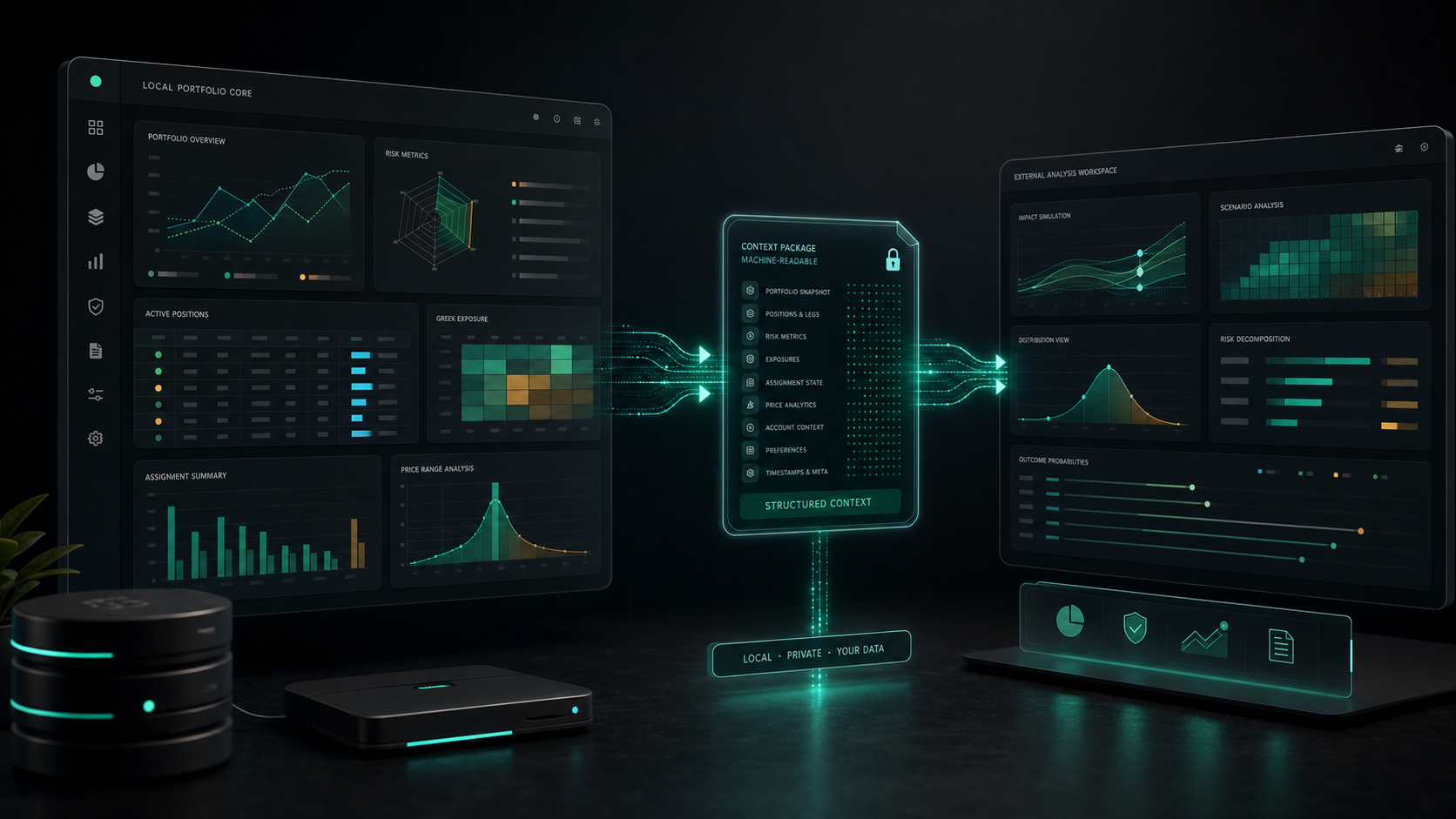
A mature trading journal should do more than display rows. It should organize portfolio context in a way that other review workflows can use. GammaLedger includes structured context-building logic for portfolio summaries, open positions, assigned positions, closed trades, risk metrics, streaks, fees, and strategy performance.
That structured context is useful for advanced analysis because it turns a local journal into a coherent dataset.
Why structure matters
Raw trades are detailed, but they are not always easy to reason about. A portfolio review often needs summarized questions:
- What are the largest active risks?
- Which strategies drive realized P&L?
- How much capital is tied up in open positions?
- Which assigned positions are uncovered or partially covered?
- Are fees consuming a meaningful share of realized turnover?
- What changed in recent trades?
GammaLedger calculates and organizes this context so analysis does not have to start from scratch every time.
What the context includes
The structured portfolio context can include:
- Portfolio-level performance metrics.
- Open position summaries.
- Closed trade summaries.
- Assigned position details.
- Strategy and ticker performance.
- Fee impact.
- Streak and drawdown context.
- Wheel and PMCC coverage signals.
- Leg-level detail where relevant.
That gives external review tools a cleaner input than a giant unfiltered export.
AI-assisted analysis with guardrails
Structured context is especially useful for AI review. Instead of asking a model to interpret a raw database file, GammaLedger can provide a curated snapshot with the fields needed for the question.
This does not remove the privacy decision. If an AI provider is used, submitted context may be processed by that provider. The value of structure is that you can keep prompts focused and avoid sending irrelevant data.
A good AI workflow asks targeted questions:
- “Identify the top three open risks from this context.”
- “Compare closed covered calls against cash-secured puts.”
- “Summarize assigned positions that lack full call coverage.”
- “Explain whether fees are material relative to realized turnover.”
External analysis without losing ownership
Structured context also helps non-AI workflows. Quantitative traders may want to compare GammaLedger summaries with spreadsheet models. Portfolio managers may want to generate periodic review notes. Developers may want to build local scripts around exported data.
The local-first model still matters here. GammaLedger can be the place where trade data is normalized and enriched, while external workflows use exports or context snapshots only when you choose.
Review workflows compound
The more consistent your journal, the more valuable structured context becomes. Clean imports, correct leg ordering, reviewed trade notes, and reconciled fees all improve downstream analysis.
Think of GammaLedger as a workflow stack:
- Capture executions as normalized legs.
- Merge and review imported records.
- Derive lifecycle and P&L.
- Summarize strategy and risk context.
- Export or submit only the context needed for the review.
That stack lets active traders move from raw broker activity to decision-quality analysis without turning every review into a manual spreadsheet rebuild.